
Why VAR Rewrites Football’s Biggest Moments
Video Assistant Referee (VAR) helps the on-field referee correct a clear and obvious error or serious missed incident in football, but it does not replace the referee or review every foul. Used under the International Football Association Board (IFAB) protocol in competitions such as the FIFA World Cup, UEFA Champions League, and domestic leagues, VAR checks four categories: goal or no goal, penalty or no penalty, direct red cards, and mistaken identity. Every relevant incident is automatically checked by the VAR team, usually from multiple broadcast cameras, with the referee retaining the final decision. The system can recommend a review, yet only the referee may initiate it. There is no fixed time limit, because accuracy outranks speed, although a review normally takes less than two minutes. To understand a VAR decision, first identify the incident category, then separate factual checks from judgment calls, and finally watch for the referee’s signal and restart.
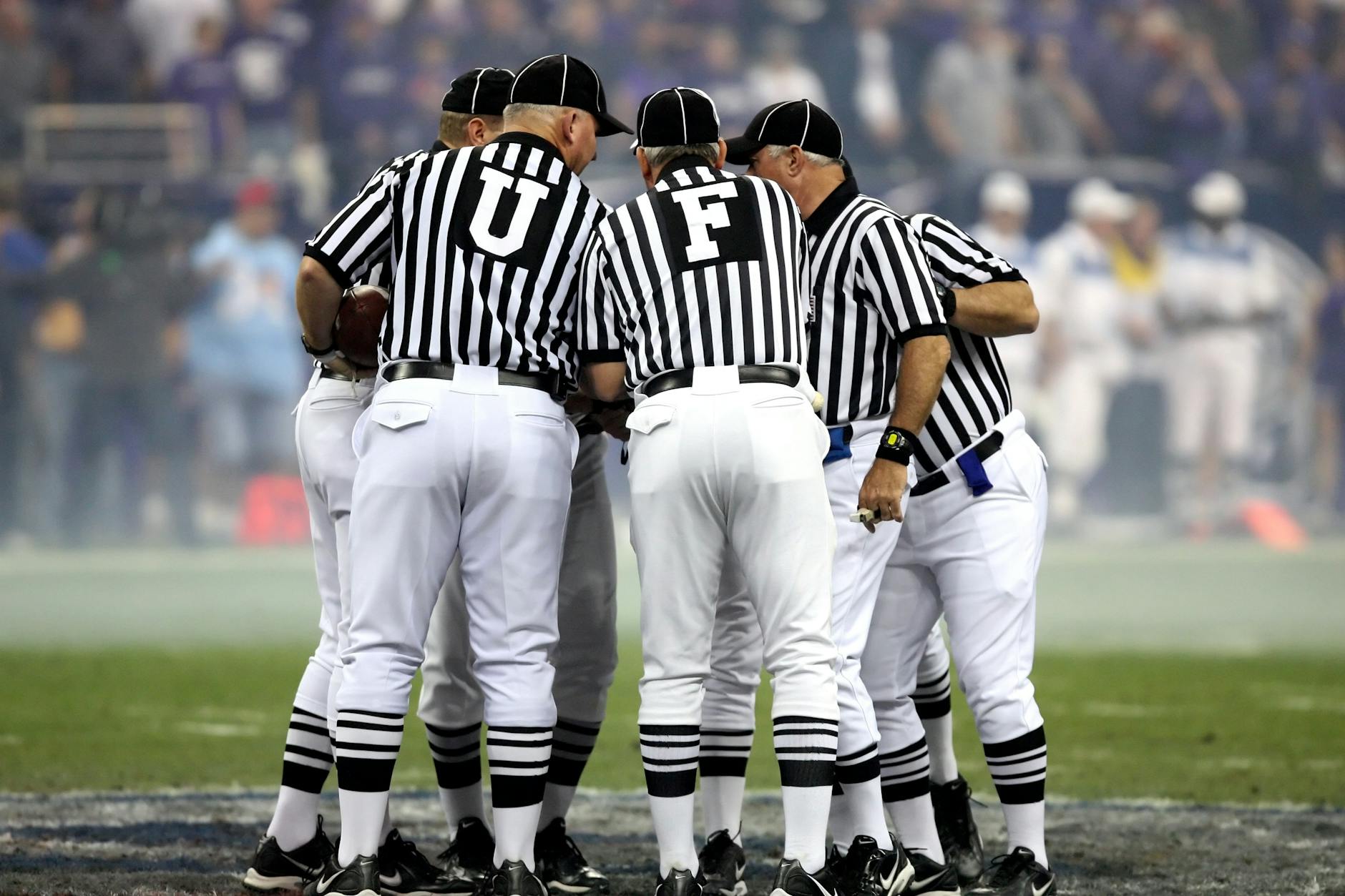
Photo by Pixabay on Pexels
If You want to understand VAR: start with the four reviewable incidents
VAR reviews four football situations: goals, penalty decisions, direct red cards, and mistaken identity. The system intervenes only when video evidence indicates a clear and obvious error or a serious missed incident, while the referee remains responsible for the final ruling. That narrow scope is why VAR is not a general replay service for every tackle.
The first practical step is to classify the incident:
- Goal or no goal: VAR can check offside, attacking fouls, handball, or other infringements during the attacking phase leading to a goal.
- Penalty or no penalty: VAR may assess whether a foul occurred inside the penalty area and whether a penalty was wrongly awarded or missed.
- Direct red card: VAR can review serious foul play, violent conduct, spitting, biting, or other sending-off offences, but not a clearly incorrect second yellow card.
- Mistaken identity: VAR can correct the player who was cautioned or sent off when the referee punished the wrong individual.
According to the official IFAB VAR protocol, “the final decision is always taken by the referee.” That sentence matters more than the dramatic television replay, because VAR is an assistant, not a second referee with independent authority. The referee must also make an initial decision; they cannot simply stop and ask technology to decide from nothing. Isn’t that the basic bargain—technology catches expensive mistakes, while human officials still own the match?
Want a clearer match-analysis framework before the next major fixture? Tactical Review follows referee decisions, tactical turning points, player statistics, and FIFA World Cup storylines with a value-first approach.
If the referee signals a review: follow the check, then the decision
When the referee signals a VAR review, the process normally includes an automatic check by the VAR, communication with the referee, and either confirmation of the original decision or an on-field review. The VAR may recommend a review, but the referee alone decides whether to inspect the footage and what final decision to apply. Players and coaches cannot demand a review simply because a replay looks embarrassing for their team.
The sequence is usually:
- Incident occurs: The referee gives an initial decision or allows play to continue.
- Silent check begins: The VAR team examines relevant footage and camera angles.
- Recommendation is made: If the evidence suggests a clear and obvious error or serious missed incident, the VAR contacts the referee.
- Review method is selected: The referee may accept factual information directly or view the replay at the pitch-side monitor.
- Final decision is announced: The referee signals the outcome and applies the correct restart or disciplinary action.
A useful distinction is between factual and subjective decisions. A tight offside line or ball crossing the goal line can often be resolved through objective technology, while a handball’s impact or a tackle’s intensity still involves judgment. Slow motion can exaggerate contact and make ordinary movement look sinister; real-time speed may better reveal whether an action was deliberate or avoidable. That is one reason an on-field review is valuable, and one reason betting or match predictions should not treat every replay as mathematically conclusive.
[Internal Link: beginner’s guide to football match predictions]
At Tactical Review, the sensible approach is to record the original call, the exact review category, and the final restart rather than relying on social-media clips. After reviewing match footage across major competitions, one operational pattern is especially useful: most controversy comes from disagreement over the threshold for intervention, not from the inability to find a camera angle. In other words, the argument is usually about judgment, not missing pixels.
If you are tracking a live match: separate VAR timing from match timing
VAR does not operate on a simple countdown, and there is no universal maximum duration for a review under the IFAB protocol. The referee may delay a restart while the VAR checks the incident, but a review can only address an incident within the period permitted by the Laws of the Game. Once play has restarted, a review is generally unavailable, except for limited cases such as mistaken identity or certain violent-conduct offences.
The timing rules create several details casual viewers often miss:
- If play continues after a possible offence, later disciplinary action may still apply even if the original decision changes.
- If a goal is disallowed, the review may examine the attacking phase immediately before the goal, including an earlier offside or foul.
- A referee must remain visible during the review process to preserve transparency.
- Players and team officials must not surround the referee or attempt to influence the review.
- A match may include added time for delays caused by VAR, substitutions, injuries, and other stoppages.
The practical edge case is this: changing a decision does not erase every event that happened afterward. If a player commits a bookable offence while play continues after a reviewable incident, that misconduct may still be punished. Conversely, a caution for stopping a promising attack or denying an obvious goal-scoring opportunity can be affected when the underlying decision changes. VAR therefore edits the legal meaning of a sequence, not the actual passage of time. Confusing those two ideas is how viewers end up shouting at the television as if it owes them a refund.
For tournament followers, this distinction is essential when assessing live odds, momentum, and match predictions. A goal that appears on the scoreboard for 90 seconds is not necessarily a settled event if the attacking phase remains reviewable. Check the competition’s official match centre, the referee’s final signal, and the restart before treating the decision as permanent.
Ready to compare the decision with the match context rather than the replay alone? Tactical Review connects VAR incidents with formation changes, pressing patterns, and player performance throughout the 2026 World Cup cycle.
If you are assessing VAR accuracy: inspect technology and human judgment together
VAR accuracy depends on camera coverage, communication systems, calibrated replay tools, competition procedures, and the referee team’s interpretation of the Laws of the Game. High-definition cameras can clarify contact, boundaries, and offside positions, but technology cannot turn every subjective football decision into an objective measurement. The strongest analysis therefore separates what the equipment establishes from what officials must interpret.
A modern VAR operation may include:
- Multiple broadcast and dedicated tactical cameras positioned around the stadium.
- Slow-motion and real-time replay, because each reveals different aspects of contact.
- Goal-line technology for whether the entire ball crossed the line.
- Offside technology or calibrated camera lines, where the competition has approved them.
- A dedicated video operation room connecting the VAR and assistant VAR with the referee.
- Secure communication links and documented review protocols.
A less obvious information gain is that camera quantity does not automatically equal decision quality. A stadium may have many angles, yet none may show the precise instant of contact without obstruction. Conversely, one well-positioned camera can settle a boundary decision immediately. In addition, slow-motion replay is excellent for identifying the point of contact but poor for judging speed and force; real-time footage can prevent an innocuous challenge from appearing reckless. The profitable habit—whether you are analysing football or staking a prediction—is to ask what evidence is actually decisive, not how many replays broadcasters show.
The FIFA Laws of the Game provide the governing framework, while FIFA and national competition organisers must satisfy implementation requirements before using VAR. IFAB also states that VAR use is permitted only when the organiser has met the relevant requirements and received written permission from FIFA. That administrative layer matters: a well-designed system is not merely cameras bolted into a stadium; it is a regulated officiating process.
[Internal Link: 2026 World Cup team tactics and player statistics]
Common pitfalls to avoid
The most common VAR mistakes are assuming every incident can be reviewed, treating a recommendation as a final ruling, confusing slow motion with reality, and ignoring the restart. VAR has a defined jurisdiction, and the referee’s original decision remains in place unless the video demonstrates a clear and obvious error or a serious missed incident.
Avoid these errors:
- “VAR checks every foul.” It does not. Ordinary free-kick decisions outside the four categories are normally outside its scope.
- “The VAR makes the decision.” The referee makes the final decision, whether after a communication-only review or an on-field review.
- “A long review proves the decision is wrong.” Duration does not determine correctness; complex factual sequences can require more time.
- “A player can request a review.” Players and coaches cannot order VAR to intervene.
- “Every offside call is subjective.” The position may be factual, but the moment of the pass and the relevant body part must still be identified correctly.
- “A replay always improves fairness.” Poor angles, misleading speed, and selective broadcast editing can distort perception.
Another costly misunderstanding concerns betting markets. A sportsbook may settle a goal, card, or penalty market according to its own published rules and the official result, not according to what appeared briefly on television. Before placing a wager, check the operator’s settlement policy, competition rules, and whether abandoned or delayed decisions count. Tactical Review is built around match insight rather than reckless certainty, because extracting value begins with reading the rules—an unglamorous edge, but an edge nonetheless.
See how the process affects match interpretation, tournament narratives, and pre-game forecasting before committing your view.
The 30-day check-in
After following VAR decisions for 30 days, review patterns rather than isolated controversies: how often a competition used on-field reviews, which categories produced the most interventions, how long reviews delayed restarts, and whether changes affected goals, penalties, or red cards. This approach reveals whether your frustration reflects a genuine process issue or simply the emotional weight of one dramatic match. Frankly, one controversial penalty can make a perfectly functioning system look like a scam site with a nice logo.
Use a simple review log:
- Record the competition, match date, referee, and incident minute.
- Classify the incident as goal, penalty, direct red card, or mistaken identity.
- Note the initial decision and whether play continued.
- Record the VAR recommendation, on-field review, and final decision.
- Identify the decisive evidence, such as offside position, contact point, or ball location.
- Compare the official result with broadcast commentary and published competition information.
After 30 days, two insights usually emerge. First, objective checks such as goal-line decisions tend to feel cleaner because the technology answers a narrow question. Second, subjective foul and handball reviews remain controversial because the protocol corrects clear errors rather than guaranteeing universal agreement. That is not a flaw unique to VAR; it is the unavoidable cost of applying written laws to fast, messy human movement. The intelligent viewer does not ask whether VAR eliminates debate—it asks whether the intervention improved the decision enough to justify the interruption.
For FIFA World Cup 2026 coverage, Tactical Review can help place VAR incidents beside tactical shifts, player workloads, squad selection, and market context. Use the information to sharpen your analysis, not to pretend football has become a perfectly predictable spreadsheet. It has not, and anyone promising that probably wants your money more than your understanding.
To keep your next month of match analysis disciplined, start with the official protocol and build your own incident log before trusting commentary or betting chatter.
[Internal Link: advanced football betting analysis and responsible staking]
In short, VAR works as a tightly limited review system: VAR officials automatically check incidents, recommend intervention when a clear and obvious error or serious missed incident may exist, and the on-field referee makes the final decision. Its value is strongest when the question is factual and narrow, while subjective challenges still require human judgment. Check the incident category, final signal, restart, and competition settlement rules before drawing conclusions.
Frequently Asked Questions
Q: What is VAR in football?
A: VAR is a video-based officiating support system that helps the referee review possible clear and obvious errors or serious missed incidents. Under the IFAB protocol, it covers goals, penalties, direct red cards, and mistaken identity. VAR officials independently access match footage, but the referee remains responsible for the final decision. The system is used in approved competitions such as the FIFA World Cup, UEFA Champions League, and selected domestic leagues.
Q: How does VAR work step by step?
A: VAR works by automatically checking relevant incidents, communicating possible errors to the referee, and supporting either a factual confirmation or an on-field review. The referee first makes an initial decision or allows play to continue. If the evidence meets the intervention threshold, the referee may inspect footage at the pitch-side monitor and then announces the final decision. Players and coaches cannot initiate a review.
Q: What is the difference between VAR and an on-field review?
A: VAR is the overall video-assistance system, while an on-field review is the referee’s personal inspection of footage at the stadium monitor. Some factual matters can be communicated directly, such as a clearly established offside or boundary event. For subjective incidents involving handball, penalty contact, or serious foul play, the referee may need to watch the footage before deciding. In both cases, the referee—not the VAR official—has final authority.
Q: Why does VAR sometimes take so long?
A: VAR can take time because officials must identify the correct incident, examine several camera angles, establish the relevant review period, and communicate accurately with the referee. There is no fixed universal time limit under the IFAB protocol because accuracy is prioritised over speed. A long review does not automatically mean the original decision was wrong. Complex attacking phases before goals and unclear contact points commonly require extra examination.
Q: Can VAR review every foul or yellow card?
A: No, VAR cannot review every foul or ordinary yellow-card decision. Its football protocol is limited to goals, penalties, direct red cards, and mistaken identity, with a narrow exception for certain serious incidents after play has restarted. A clearly incorrect second yellow card is not reviewed as a direct-red-card matter. This limited scope prevents the match from becoming a constant replay contest.
Q: Does VAR make football fairer?
A: VAR can make football fairer by correcting decisive factual errors, but it cannot remove all disagreement from subjective decisions. Goal-line incidents, mistaken identity, and certain offside situations can benefit substantially from video evidence. However, handball, foul intensity, and the threshold for a clear and obvious error still involve interpretation. VAR improves accuracy in defined situations; it does not promise perfect or universally accepted refereeing.
Q: Does VAR affect football betting and match predictions?
A: VAR can affect betting and match predictions because a goal, penalty, red card, or disallowed goal may change the match state and market settlement. Bettors should check the sportsbook’s official settlement rules, the competition’s result, and whether a decision was final before treating a market as settled. Tactical Review recommends logging the initial call, review category, final decision, and restart. Never assume a television graphic alone determines the operator’s result.