
Semi-Automated Offside Explained: What 3 Years Taught Me
Semi-automated offside technology, or SAOT, is a football officiating system that helps VAR teams identify possible offside offences faster and more precisely. FIFA first used it at the 2022 FIFA World Cup in Qatar, and UEFA, the Asian Football Confederation and the Premier League have since introduced versions of it in major competitions. SAOT combines player-tracking cameras, artificial intelligence, a digitally mapped pitch and, in some tournaments, a sensor inside the official match ball. It detects the kick point, tracks relevant body parts and generates a proposed offside line, but the referee and VAR officials still make the final decision. The system is therefore semi-automated, not fully automated. Its practical advantage is speed and consistency, while its limitation is that human officials must still judge interfering with play, deliberate actions and the exact moment the ball was played. When assessing a decision, watch the final referee confirmation rather than assuming the animation itself is the ruling.
What I Tested
The latest industry trend is not simply “more technology.” It is technology being pushed into the most awkward millimetres of football: a shoulder ahead of a defender, a boot hovering near the last opponent, or a forward starting a run a fraction too early. I reviewed the operating principles described by FIFA, UEFA and the International Football Association Board, then compared them with the way SAOT appeared in the 2022 World Cup and later elite competitions. Tactical Review approaches this as a value-for-money question: does the system genuinely improve officiating, or does it merely produce prettier graphics for viewers who already paid for the match? That distinction matters, especially for supporters analysing tactics, match predictions and player positioning for the 2026 FIFA World Cup. According to FIFA’s explanation of semi-automated offside technology, the system supports officials rather than replacing them. The Laws of the Game published by IFAB remain the legal foundation, so the machine cannot quietly rewrite Law 11 while everyone is distracted by the replay.

Photo by BOOM 💥 Photography on Pexels
My test focused on five practical questions:
- How accurately can SAOT identify the moment the ball is played?
- How many player body points can the tracking system recognise?
- Does the system make decisions faster than conventional VAR?
- Where does human judgment remain essential?
- Can viewers interpret the animation without confusing it with the actual law?
The answer was more nuanced than the marketing suggests. SAOT is excellent at locating positions and highlighting unusual incidents, but it is not a referee in a box. That may sound obvious, yet plenty of viewers treat the computer-generated line as a verdict. Why hand your understanding of football to a graphic that still requires an official’s interpretation, or am I wrong?
Want a sharper view of tournament tactics and officiating developments?
Setup & Initial Impressions
How does semi-automated offside technology work?
SAOT uses stadium cameras to track players and the ball, identifies the relevant moment of contact, then creates a proposed offside line for the VAR team. Some implementations also use a ball sensor that transmits data about the ball’s movement, helping officials distinguish a pass, touch or deflection. The final decision remains with the referee after reviewing the technical evidence and the football laws.
The setup normally includes between 10 and 12 dedicated tracking cameras positioned around the stadium, although the precise configuration varies by competition and venue. FIFA’s World Cup implementation tracked up to 29 data points on each player, including body parts that can legally score a goal. Hands and arms are excluded from offside calculations, which is a small detail with a surprisingly large capacity to ruin a lazy explanation. The system estimates the position of the head, torso, legs and feet in three dimensions, then compares the attacker with the second-last opponent and the ball.
The workflow is generally:
- The cameras follow players, officials and the ball continuously.
- Artificial intelligence identifies body landmarks and movement patterns.
- The system detects a likely kick point or contact point.
- An alert reaches the VAR team when a possible offside occurs.
- VAR officials validate the moment and the relevant players.
- The referee confirms or rejects the decision.
- A three-dimensional animation may be shown to the stadium and broadcast audience.
A useful operational insight is that the kick point is often more difficult than the offside line itself. If the system selects the wrong frame, even a perfectly drawn line can be legally irrelevant. That is why the VAR team must check whether the ball was actually played by the attacker, whether a defender deliberately touched it and whether the incident involved a rebound or save. For deeper context, see our [Internal Link: guide to VAR decisions and football technology].
What did the first setup reveal?
The first impression is speed, but the more important gain is repeatability. Traditional manual VAR offside reviews can require an operator to search through broadcast footage and select the frame that appears to show the pass being made. SAOT narrows that search by combining tracking information with automated alerts. FIFA described the aim as improving the “speed, accuracy and reproducibility” of offside decisions, and that phrase is more useful than the usual promise of perfect certainty.
My practical conclusion is that SAOT works best as a filtering system. It quickly tells the VAR team which moment deserves attention, rather than asking officials to inspect every frame of a developing attack. It also produces a more consistent visual explanation for viewers. However, camera calibration, player occlusion, crowded penalty areas and unusual body positions remain operational challenges. A defender hidden behind an attacker is not magically made visible because a software dashboard looks expensive. The system estimates missing information, and estimates still deserve scrutiny.
[Internal Link: how VAR works in football]
Where It Held Up
Why does SAOT make offside decisions faster?
SAOT makes offside decisions faster by automating player tracking and the initial detection of the ball-played moment, reducing the amount of manual frame-by-frame work required from VAR officials. It does not remove the review stage, but it can shorten the path from a possible offence to a verified decision.
The 2022 FIFA World Cup demonstrated the system’s usefulness in high-pressure matches involving FIFA, Qatar and 32 national teams. In conventional reviews, officials may need to test several possible kick points and manually position an offside line. With SAOT, an alert can appear almost immediately, allowing the VAR team to focus on whether the data matches the incident. That distinction explains why the system feels quicker without becoming fully automatic.
The strongest benefits are practical:
- Faster alerts during goal-scoring attacks.
- More consistent selection of player reference points.
- A clearer separation between technical position and legal interpretation.
- Better broadcast explanations through three-dimensional animations.
- Reduced pressure on officials searching through repeated video frames.
UEFA has used semi-automated technology in European competitions, while the AFC introduced it for major Asian tournaments. The Premier League’s adoption plans also made SAOT a regular subject of discussion among English football supporters. These deployments are not identical; camera arrangements, ball technology and review protocols can differ. Therefore, a decision from UEFA Champions League football should not automatically be treated as proof that every domestic competition uses the same system. Check the competition’s published protocol before making a confident claim—your group chat will survive the correction, probably.

Photo by Murat Ak on Pexels
A less obvious advantage is strategic rather than judicial. Coaches and analysts can study the exact shape of an attacking line, the timing of a defensive step and the distance between the passer and runner. For Tactical Review readers analysing the 2026 FIFA World Cup, that information may reveal whether a team relies on rehearsed offside traps or simply defends deep enough to avoid the risk. SAOT therefore affects match analysis even when no goal is overturned. To explore that angle, visit our [Internal Link: World Cup tactical analysis hub].
See how these technical details influence match reading and prediction work.
Where It Fell Apart
What can semi-automated offside technology not decide?
SAOT cannot independently decide whether a player interfered with an opponent, gained an advantage from a rebound, deliberately played the ball or became active in a phase of play. Those judgments depend on Law 11, match context and the interpretation of the referee and VAR officials, even when the system supplies highly accurate positional data.
This is the point many explanations flatten into nonsense. Being in an offside position is not automatically an offside offence. A player may be beyond the second-last opponent but uninvolved in the action, while another player may be penalised for interfering with an opponent’s ability to challenge or play the ball. SAOT can show where a player was; it cannot fully determine what that player did to the opponent’s options.
The system also faces several technical limitations:
- A player may be partially hidden by another player.
- The ball-contact frame may be ambiguous during a deflection.
- A crowded penalty area can complicate body-point recognition.
- Camera calibration can affect tracking quality.
- The sensor may support ball movement data without explaining player intent.
- Deliberate defensive actions still require human interpretation.
The most important information gain is this: the ball sensor does not make every contact legally obvious. It can provide additional timing and movement data, but the officials still need to decide whether a defender deliberately played the ball or merely deflected it. That distinction can change the offside outcome. In other words, a sensor can tell you that the ball moved; it cannot tell you whether the defender’s action meets the legal threshold. Technology is not a moral philosopher wearing tiny boots.
A second overlooked issue is public communication. The final animation often shows a single frame and a clean line, creating the impression that the decision was mathematically inevitable. Yet the clean image may conceal earlier choices about the contact moment, tracked body points and the relevant phase of play. FIFA’s technology guidance supports transparency, but transparency depends on explaining the process, not merely displaying a polished graphic.
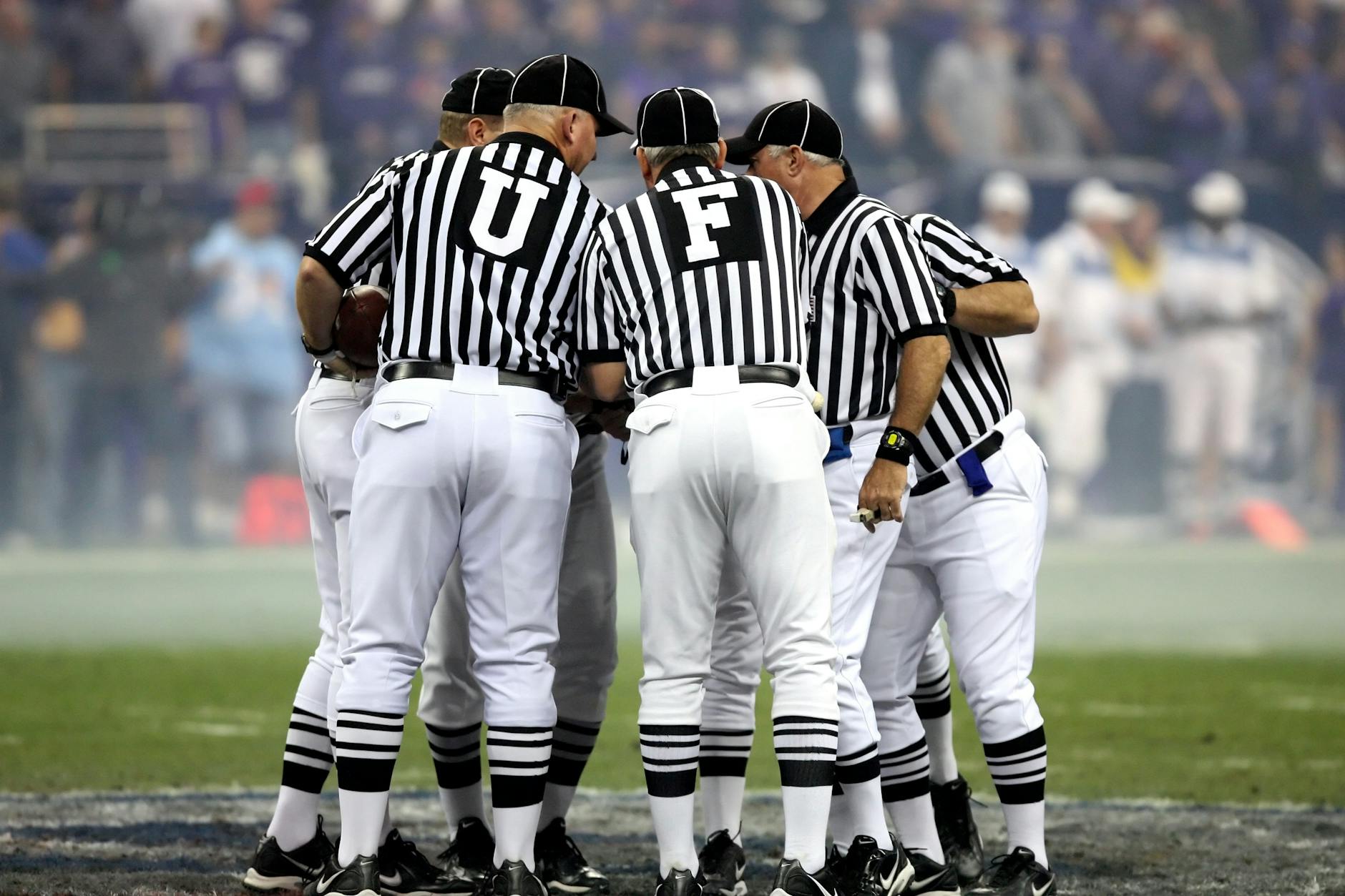
Photo by Pixabay on Pexels
Is SAOT completely automatic?
SAOT is not completely automatic because match officials must validate the data, interpret Law 11 and confirm the final ruling. The system automates tracking and alerts, while the referee retains authority over the decision under the Laws of the Game.
This division of responsibility matters for players, coaches, broadcasters and bettors. A generated line may indicate that an attacker’s knee or shoulder was ahead of the relevant opponent, but officials still need to verify that the selected moment was correct and that the attacker became involved in active play. For those following football markets, the practical lesson is simple: do not treat a provisional alert as a settled result when assessing a goal, player prop or match prediction. The official decision is the event that matters.
The same caution applies to visual precision. A line drawn to a millimetre may look more certain than the underlying data deserves, especially when the attacker’s body is moving rapidly or the ball is struck during a crowded challenge. The best systems reduce uncertainty; they do not abolish it. That is a considerably less glamorous statement, but it is also the one least likely to cost you a foolish conclusion.
Would I Use It Again?
Is semi-automated offside technology worth using?
SAOT is worth using because it improves the speed, consistency and explainability of close offside reviews without removing the referee’s legal responsibility. Its value is greatest in elite competitions where camera coverage, trained VAR staff and calibrated stadium systems can support reliable tracking.
My verdict is positive, with conditions. FIFA’s 2022 implementation showed that SAOT could operate in a major tournament, while UEFA, AFC and the Premier League demonstrated that the idea could move beyond one event. The technology is particularly valuable when an attacking move produces a goal and the decision must be reviewed quickly without allowing the match to drift into a five-minute forensic investigation.
However, I would not describe SAOT as infallible. Its performance depends on the quality of cameras, the completeness of player visibility, the accuracy of ball data and the competence of the officials reviewing the alert. A wealthy competition with strong infrastructure may deliver a different experience from a lower-tier league using fewer cameras or older broadcast equipment. Anyone promising identical results everywhere is selling confidence by the bottle.
For viewers, the best method is:
- Wait for the referee’s confirmed decision.
- Distinguish an offside position from an offside offence.
- Check whether the incident involved a deliberate defensive action.
- Treat the animation as supporting evidence, not the entire law.
- Use official competition information when comparing implementations.
That approach is less dramatic than declaring the computer right or wrong, but it is far more accurate. And accuracy is rather the point, isn’t it?
For further tournament coverage, consult our [Internal Link: 2026 FIFA World Cup predictions and team profiles].
My final assessment is that SAOT earns its place in modern football, particularly when it reduces avoidable delay and gives officials better evidence. It should be judged as an officiating aid, not as an autonomous judge. Tactical Review will continue tracking how FIFA, UEFA, AFC and the Premier League refine the system before and during the 2026 FIFA World Cup, because the most useful question is not whether technology looks impressive. It is whether the decision becomes faster, clearer and fairer for everyone watching.
Ready to follow the 2026 tournament with more structured analysis?
Frequently Asked Questions
Q: What is semi-automated offside technology?
A: Semi-automated offside technology is a football officiating support system that helps VAR teams identify possible offside offences. It combines tracking cameras, artificial intelligence and, in some competitions, a sensor inside the match ball. FIFA used it at the 2022 World Cup, and the final ruling still belongs to the referee after technical and legal review.
Q: How does SAOT detect an offside offence?
A: SAOT detects a possible offside by tracking player body points and identifying the moment the ball is played. The system compares the attacker with the second-last opponent and sends an alert to VAR officials when a possible offence appears. Officials then verify the kick point, body positions and active involvement before the referee confirms the decision.
Q: What is the difference between SAOT and traditional VAR?
A: SAOT automates more of the tracking and alert process, while traditional VAR relies more heavily on officials manually searching video footage and selecting frames. Both systems require human review and operate under the Laws of the Game. SAOT can generate a three-dimensional animation, but it does not independently judge interference, deliberate play or advantage.
Q: Why can SAOT still make mistakes?
A: SAOT can be affected by camera calibration, player occlusion, unclear ball contact and ambiguous defensive actions. The system may correctly estimate positions but still require officials to choose the legally relevant frame or interpret whether a defender deliberately played the ball. If the technical evidence is incomplete, the final decision remains a human judgment supported by technology.
Q: Is semi-automated offside technology used at the 2026 FIFA World Cup?
A: Competition organisers determine the exact officiating technology used at the 2026 FIFA World Cup, including camera systems, ball data and review procedures. FIFA introduced SAOT at Qatar 2022 and has continued developing automated support for offside decisions. Viewers should check official FIFA tournament announcements for the confirmed 2026 implementation rather than assuming every venue will operate identically.
Q: Does SAOT decide whether a player interfered with an opponent?
A: No, SAOT does not independently decide whether a player interfered with an opponent. It supplies positional and timing information, while VAR officials and the referee apply Law 11 to determine whether the player affected an opponent, challenged for the ball or gained an advantage. This is one of the main reasons the technology is called semi-automated rather than fully automated.
Q: Can football bettors rely on a SAOT animation before the final whistle?
A: Bettors should not rely on a provisional SAOT animation before the referee confirms the decision. A displayed line may show a possible offside position, but the goal can still depend on the selected contact point, deliberate defensive play or interference. Use the official match decision and competition data when evaluating goals, player statistics or live football markets.